
Habit formation calculator
Enter your habit and the day you started: the calculator shows when it should start to feel automatic, based on the research, and a 4-question test tells you how automatic it already is.
When will it feel automatic?
A daily routine that takes some effort, like reading or a walk.
Is it a habit yet?
Rate each sentence about “My habit”, from 1 (strongly disagree) to 7 (strongly agree).
Answer the 4 questions to see your score.
How long does it really take to form a habit?
The most cited study on the question was run at University College London and published in 2009. 96 volunteers chose a new daily behavior, like drinking a glass of water at lunch or running before dinner, and reported each day for 12 weeks how automatic it felt. Among the 39 people whose data followed the model well, the median time to get close to the plateau of automaticity was 66 days, but the estimates ranged from 18 to 254 days, depending on the person and the behavior.
A 2024 review of 20 studies on health habits found two medians, 59 and 66 days, and people who took from 4 to 335 days. A 2023 study in PNAS used machine learning on more than 30,000 gym-goers over four years and more than 3,000 hospital workers. Going to the gym took about six months to become a habit; hand-washing at work took a few weeks.
Where does the 21-day rule come from?
Not from research on habits. The figure goes back to the 1960 book Psycho-Cybernetics, by the plastic surgeon Maxwell Maltz, who observed that his patients needed about 21 days to get used to a change in their appearance. Over the years, "a minimum of about 21 days" became "21 days to form a habit". The research above shows that most habits take longer.
How the calculator works
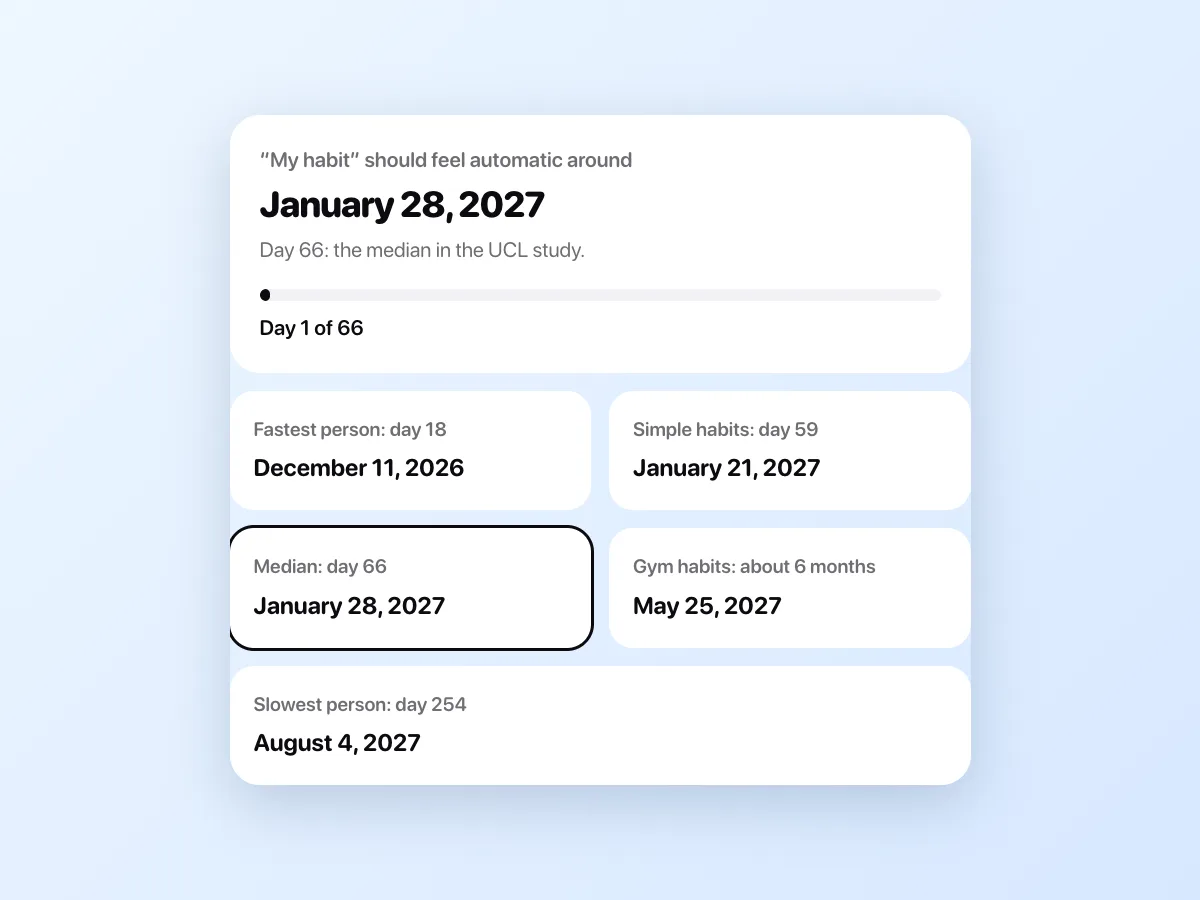
The calculator counts from the day you started and shows five milestones from the research: the fastest person in the UCL study (day 18), the median of its drinking habits (day 59), its overall median (day 66), the gym habits of the PNAS study (about six months) and the slowest person in the UCL study (day 254). The type of habit you choose decides which one is highlighted.
These are estimates, not promises. In the UCL study, drinking, eating and exercise habits had medians of 59, 65 and 91 days, but the groups were small and the difference was not statistically significant. The study lasted 84 days, so the longest durations are projections. Your habit may settle sooner or later; what matters is to keep going past the first weeks.
The 4-question habit test
Researchers do not measure a habit by counting days, but by asking how automatic it feels. The 4 questions on this page follow the Self-Report Behavioural Automaticity Index, a short scale published by Benjamin Gardner, Phillippa Lally and colleagues in 2012 and used in habit research. A high average means the behavior runs on its own; a low one means it still depends on willpower. Our three bands are a rough guide for personal use, not a clinical cut-off.
How to make a habit stick faster
Keep the same cue: in the PNAS gym study, 69% of gym-goers were more likely to go on the same days of the week, and the time since the last visit mattered for 76% of them. Start small, so the habit survives your worst day. And if you miss a day, start again the next one: in the UCL study, missing a single day did not hurt habit formation. To count your days, print a 66-day challenge sheet or read why New Year's resolutions fail.
Frequently asked questions
Related articles
How Long Does It Take to Form a Habit? What Research Says
About two months for a simple habit, six for the gym: what the studies really say about habit formation, why the 21-day rule is wrong, and how to speed it up.
4 min read
Never Miss Twice: What to Do When You Break a Streak
Missing one day does not ruin a habit, missing two often does. How the never miss twice rule works, how to restart a broken streak, and streaks vs progress.
2 min read
Habit Statistics 2027: 32 Facts with Their Sources
Habit statistics from primary research and official sources only: how many habits we have, how long they take to form, resolutions, streaks, tracking and apps.
5 min read