
Why New Year's Resolutions Fail (and 7 Research-Backed Fixes)
Why many New Year's resolutions fail, what research says about it, and 7 simple fixes to make your 2027 resolution stick past Quitter's Day.
Trackware · · 5 min read
New Year's resolutions often fail because they describe a result instead of a daily action. In the studies of psychologist John Norcross, 54% to 60% of resolvers were no longer on track after six months (1988, 2002). It is not only a lack of willpower: most resolutions are wishes, not habits.
Research on goals and habits points to a handful of reasons. Each one has a simple fix you can apply before January 1, or right now if January has already started.
1. It describes a result, not an action
"Get fit", "be happier", "save money": these are outcomes. You cannot do "get fit" on a Tuesday evening. When a resolution has no daily action, there is nothing to start and nothing to check off, so it slowly disappears.
The fix: rewrite the resolution as an action with an amount and a rhythm. "Get fit" becomes "walk 7,000 steps a day". "Save money" becomes "log every expense the same day". We rewrote 60 common resolutions this way if you need a starting point.
2. It is about stopping something
"Stop eating sugar", "quit social media", "no more takeout". Resolutions phrased as avoidance seem a little harder to keep. In a one-year Swedish study published in PLOS ONE, 58.9% of people with approach goals considered themselves successful, against 47.1% of people with avoidance goals, a small effect (Oscarsson et al., 2020).
The fix: replace the thing you want to stop with something you start. "Stop scrolling in bed" becomes "read 10 pages in bed". "Quit sugar" becomes "fruit or nuts for my afternoon snack". You still reach the same goal, but you have an action to perform instead of a temptation to resist.
3. It is too big for a bad day
A resolution that works on a calm Sunday breaks on a busy Thursday. "Run 5 km every day" holds as long as nothing goes wrong, then one bad day turns into a lost week.
The fix: give every resolution a minimum. "Run 5 km, or at least put on my shoes and walk 10 minutes." The minimum keeps the habit alive on the days you have nothing left, and most of the time, once you have started, you do more.
4. It runs on January motivation
January 1 feels like a clean slate. Researchers at Wharton call this the "fresh start effect": temporal landmarks like a new year, a birthday or even a Monday make people more likely to set goals and pursue them (Dai, Milkman and Riis, 2014). The problem is that the boost fades. Strava's data shows the drop: in 2018, an analysis of 31.5 million January activities found uploads 17.3% below the expected level on the second Friday of January (Cycling Weekly), and in 2019 Strava named January 17 the fitness "Quitter's Day" for the United States (GearJunkie).
The fix: plan for the second week before it arrives. Put a reminder on Friday, January 8, 2027, the second Friday of the month, and decide now what you will do that day: the minimum version, at the usual time. And if you slip, use the next fresh start: the following Monday works too.
5. It expects results in 21 days
The idea that a habit forms in 21 days is popular, but it does not come from research on habits. In a 2009 study at University College London, volunteers repeated a new daily behavior until it felt automatic: the median was 66 days, with estimates from 18 to 254 days (UCL). A 2023 study in PNAS found that going to the gym took about six months to become a habit, while hand-washing at work took a few weeks (Caltech).
When people expect the new behavior to feel easy by late January, they read the normal effort of week four as failure, and they stop.
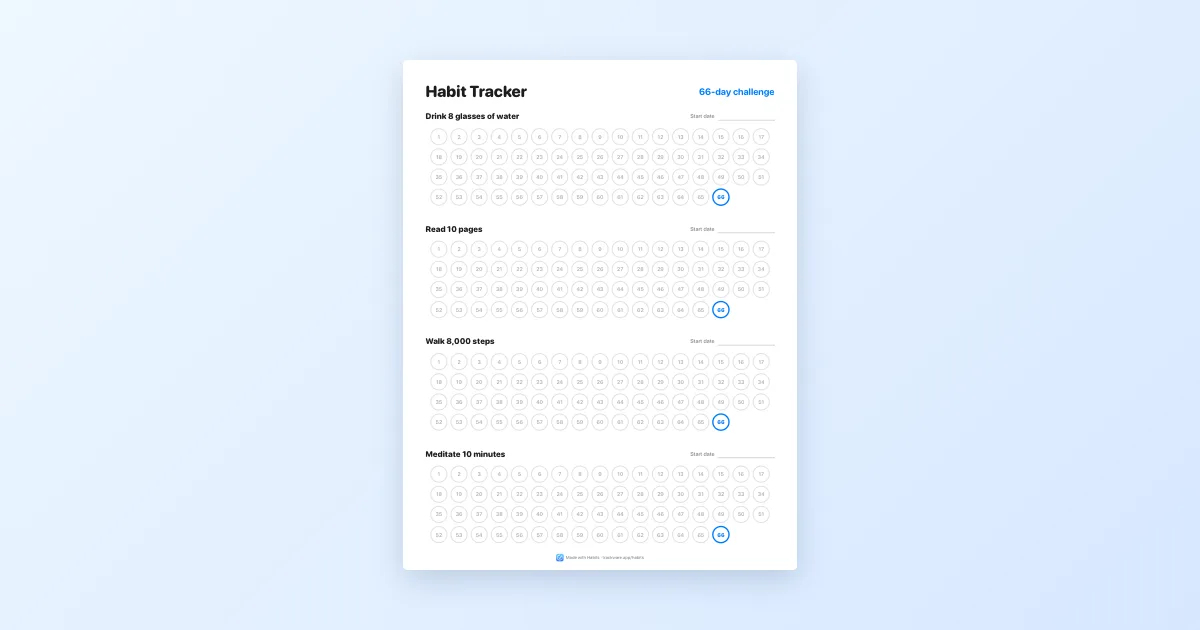
The fix: plan for at least 66 days, and count them. A 66-day challenge sheet shows you exactly how far you are, so week four feels like progress rather than a dead end.
6. It has no fixed moment
"I'll meditate sometime today" usually means "I'll meditate if I remember". Habits form when the same action follows the same cue. In the PNAS gym study, the time since the last visit mattered for 76% of gym-goers, and 69% were more likely to go on the same days of the week. Consistency, not intensity, built the habit.
The fix: attach your resolution to something you already do every day, at the same time: "after my morning coffee, I write 3 lines in my journal". Choose fixed days for weekly habits, like Monday, Wednesday and Friday for strength training.
7. One missed day ends it
The most common way a resolution dies is not a decision to quit. It is one missed day, then the feeling that the streak is broken, then a second day, then a week. In the UCL study, missing a single day did not hurt habit formation. The damage comes from what you do next.
The fix: follow one rule: never miss twice. One empty box on your tracker is normal. Two in a row is the signal to do the minimum version right away, whatever it takes.
A simple plan for January 2027
- Pick one to three resolutions, no more.
- Rewrite each one as an action you start, with an amount, a rhythm and a minimum.
- Attach each one to a fixed moment of your day or week.
- Print a tracker and put it where you will see it every day: a monthly habit tracker for January 2027 or a 66-day challenge. For a single resolution, a Year in Pixels shows the whole year on one page.
- Mark January 8 in your calendar and decide now what you will do that day.
- If you miss a day, never miss twice.
For the numbers behind this article, see our New Year's resolution statistics, where every figure links to its primary source.
If you would rather track on your phone, Habits, our habit tracker for iPhone, iPad, Apple Watch and Mac, sends a reminder at the moment you chose, shows your streak and lets you check off a habit from a widget or your Apple Watch. The free version tracks up to 3 habits, with no account.
Frequently asked questions
Related articles
New Year's Resolution Ideas for 2027: 60 You Can Actually Track
60 New Year's resolution ideas for 2027, each turned into a small daily or weekly habit you can track, with free printable trackers to start on January 1.
6 min read
New Year's Resolution Statistics 2027: What the Data Really Says
New Year's resolution statistics from primary sources only: how many people make resolutions, the most common ones, how many keep them and when they quit.
7 min read
Habit Tracker for ADHD: Track Habits Without Streak Anxiety
Habit tracking with ADHD: fewer habits, weekly goals instead of daily streaks, loud reminders and visible cues. What to look for in a habit tracker app.
3 min read