
New Year's Resolution Statistics 2027: What the Data Really Says
New Year's resolution statistics from primary sources only: how many people make resolutions, the most common ones, how many keep them and when they quit.
Trackware · · 7 min read
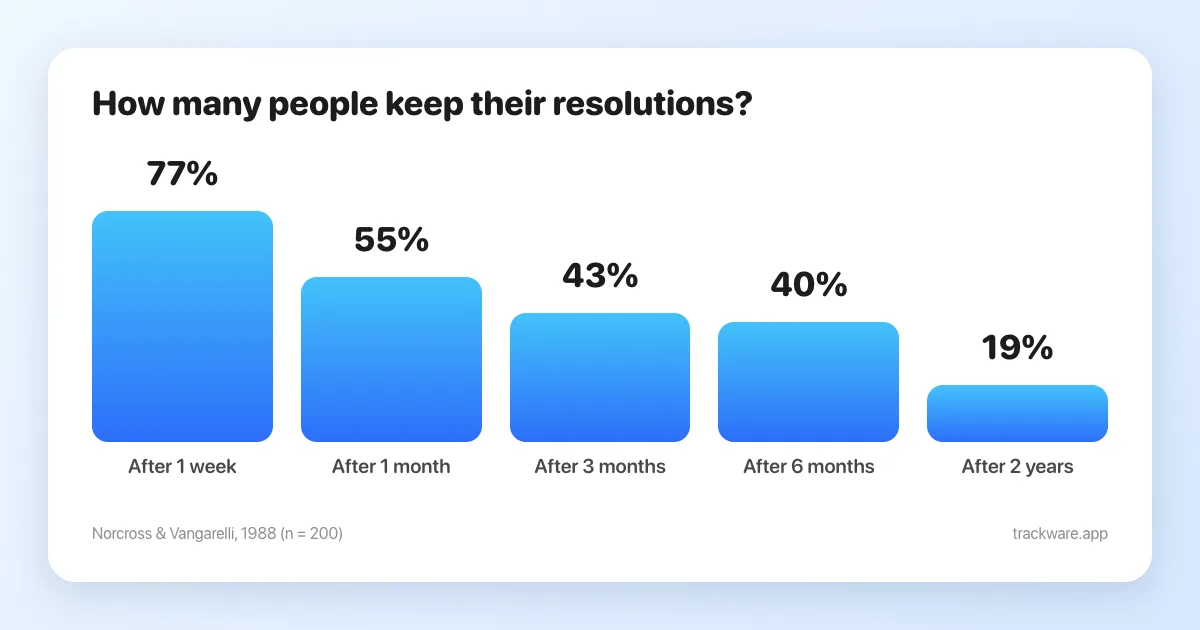
About 3 in 10 US adults make a New Year's resolution: 31% said they would make one, or set a goal, for 2026 (YouGov, December 2025), and 30% had made one in January 2024 (Pew). In two studies by psychologist John Norcross and colleagues, 77% of resolvers were still on track after one week, 40% to 46% after six months and 19% after two years.
This page only uses numbers with a named source: who ran the survey, when, with how many people, and how. Each figure links to its source, and the numbers we could not trace are listed at the end, with the reason.
The 2027 polls are not out yet. They are usually published in the last two weeks of December, and we will add them here as soon as they are. Until then, the latest data is about resolutions for 2026.
Key numbers
- 31% of US adults planned a resolution or goal for 2026 (YouGov, December 2025).
- 72% of Britons planned resolutions for 2026 (Finder, December 2025).
- Exercise, health and money are at the top of the recent polls.
- 77% after one week, 19% after two years: resolvers still on track in a study of 200 people (Norcross and Vangarelli, 1988).
- 55% of those who answered after one year considered themselves successful in a Swedish study of 1,066 people (PLOS ONE, 2020).
- 58.9% vs 47.1%: people who resolved to start something were a little more successful than people who resolved to stop something (same study).
- The second or third week of January is when Strava saw uploads drop in its data on tens of millions of workouts.
- 66 days: the median time for a new daily habit to feel automatic in a University College London study, with estimates from 18 to 254 days.
How many people make New Year's resolutions?
| Source | Population | Fieldwork | Sample | Result |
|---|---|---|---|---|
| YouGov | US adult citizens | December 9 to 11, 2025, online | 1,104 | 31% will make a resolution or set a goal for 2026 |
| Pew Research Center | US adults | January 16 to 21, 2024, online panel | 5,140 | 30% made at least one resolution for 2024 |
| Finder | Adults in Great Britain | December 12 to 15, 2025, online (Censuswide) | 2,000 | 72% will set resolutions for 2026 |
The numbers look contradictory, but the countries, the panels and the questions are different, and we could not compare the full questionnaires. The lesson is to always read the question before quoting the percentage.
Among the Americans who planned a resolution, 39% said they were very likely to keep it throughout 2026 (YouGov).
The most common New Year's resolutions
In YouGov's US poll, people could choose among 25 options. The top five for 2026 were:
| Resolution | Share of respondents |
|---|---|
| Exercising more | 25% |
| Being happy | 23% |
| Eating healthier | 22% |
| Saving more money | 21% |
| Improving physical health | 21% |
Ipsos' US Consumer Tracker, published December 17, 2025, found that "saving more money" was the most popular resolution for 2026 (Ipsos).
In Great Britain, Finder grouped resolutions by theme: health came first (35%), then money (31%), family (29%), self-improvement (28%), travel (26%), love (23%) and career (15%).
Whatever the country, the same two themes come back: the body and the bank account. Both are areas where a vague wish ("get fit", "save money") can be turned into a precise daily or weekly action. We wrote 60 resolution ideas rewritten as trackable habits for that reason.
How many people keep their resolutions?
No single number answers the question: it depends on when you ask, and whom. Here are the results we could trace, from the first week to the second year:
| When | Still on track | Who | Source |
|---|---|---|---|
| After 1 week | 77% | 200 US resolvers | Norcross and Vangarelli, 1988 |
| Late January | 59% kept all their resolutions, 28% some of them | US adults who made one, survey of 5,140 | Pew, 2024 |
| After 1 month | 55% | 200 US resolvers | Norcross and Vangarelli, as cited in PLOS ONE |
| Early March | 71% entirely or mostly | US adults who made one, poll of 1,000 | YouGov, 2024 |
| After 3 months | 43% | 200 US resolvers | Norcross and Vangarelli, as cited in PLOS ONE |
| After 6 months | 40% | 200 US resolvers | Norcross and Vangarelli, as cited in PLOS ONE |
| After 6 months | 46%, against 4% of people who wanted to change later | 159 US resolvers, 123 others | Norcross et al., 2002 |
| After 1 year | 55% of those who answered | Swedish study, 1,066 participants | Oscarsson et al., 2020 |
| After 2 years | 19% | 200 US resolvers | Norcross and Vangarelli, 1988 |
All of these are self-reported, and the questions differ: do not put them on the same curve.
The most detailed recent study is the Swedish experiment published in PLOS ONE in 2020 (Oscarsson et al.):
- 1,066 people were recruited through social media and the news in the last week of December 2016, and followed for a year.
- 55% of those who answered considered themselves successful in sustaining their resolution at the one-year follow-up. Success was self-rated on a 0 to 100% scale, and 70% or more counted as successful.
- Approach goals won: 58.9% of people who resolved to start or do something were successful, against 47.1% of those who resolved to stop or avoid something. The effect is small.
- A little support helped: participants were randomly given no support, some support or extended support. The group with some support reported the highest success scores, ahead of the group with no support, while the extended support group did not do better.
- The most common themes were physical health (33%), weight loss (20%) and eating habits (13%).
Keep two limits in mind: the participants chose to join a study about resolutions, and success was self-reported. The real-world rate is probably lower. But the study's most useful finding holds regardless: how you phrase a resolution changes your odds.
When do people give up? Quitter's Day
Not all at once. Strava, the fitness app, measured when activity drops in January:
- In 2018, an analysis of 31.5 million January activities found a drop on Friday, January 12, the second Friday of the month, with activity uploads 17.3% below the expected level (Cycling Weekly).
- In 2019, a US analysis of 108,286,060 activities named Thursday, January 17 the fitness "Quitter's Day" (GearJunkie).
So Quitter's Day is not a fixed date, and a drop in uploads is not the same as people giving up: in the surveys above, most people were still on track at the end of January. If you follow the second-Friday rule of the first analysis, Quitter's Day 2027 falls on Friday, January 8, 2027.
How long does it take for a resolution to become a habit?
- About two months for a simple habit. In a 2009 study at University College London, volunteers repeated a new daily behavior until it felt automatic. The median was 66 days among the 39 people whose data followed the model well, with estimates from 18 to 254 days. Missing a single day did not hurt the process (UCL).
- Months for complex habits. A 2023 study in PNAS used machine learning on more than 30,000 gym-goers over four years: going to the gym took about six months to become a habit, while hand-washing at work took a few weeks for more than 3,000 hospital workers (Caltech).
The popular "21 days" rule does not come from either study. A January resolution needs to survive at least until March, and for exercise, until summer.
Search data: the January spike
We looked at Google search volumes in the United States (Google Ads Keyword Planner estimates, retrieved November 23, 2026) to measure how strongly January concentrates interest in self-improvement:
| Search term | January 2026 | Monthly average |
|---|---|---|
| new years resolutions | 246,000 | 40,500 |
| 75 hard | 201,000 | 110,000 |
| dry january | 74,000 | 9,900 |
| new years resolution ideas | 40,500 | 6,600 |
| habit tracker | 33,100 | 18,100 |
Searches for resolutions are six times their yearly average in January, and searches for a habit tracker almost double. Interest in some challenges is fading, though: January searches for "75 hard" fell from 368,000 in 2024 and 2025 to 201,000 in 2026.
Statistics we could not verify
These numbers are quoted in many articles, but we could not trace them to an original study with a published method, so we do not use them:
- "92% of people fail their resolutions" (or "only 8% succeed"). Usually attributed to the University of Scranton. The studies Norcross published there say something else: 46% on track after six months, and 19% after two years.
- "80% of resolutions fail by February." Widely repeated, with no original survey behind it that we could find.
If you know the primary source for one of these numbers, we will gladly check it and update this page.
How we chose these sources
We only kept figures with a named source: public polls (YouGov, Pew, Ipsos, Finder), research studies (Norcross, PLOS ONE, PNAS, University College London) and company data (Strava). Each figure links to its source, so you can check it yourself. Polls with different questions are shown side by side, not averaged.
Turn the statistics into a plan
The data points to the same few rules: phrase your resolution as something you start, make it small enough for a bad day, expect it to take more than two months, and plan for the second week of January. Our article on why New Year's resolutions fail turns each of these findings into a concrete fix.
To keep track, print a free 66-day challenge sheet or a monthly habit tracker for January 2027.
Frequently asked questions
Related articles
Why New Year's Resolutions Fail (and 7 Research-Backed Fixes)
Why many New Year's resolutions fail, what research says about it, and 7 simple fixes to make your 2027 resolution stick past Quitter's Day.
5 min read
New Year's Resolution Ideas for 2027: 60 You Can Actually Track
60 New Year's resolution ideas for 2027, each turned into a small daily or weekly habit you can track, with free printable trackers to start on January 1.
6 min read
Habit Statistics 2027: 32 Facts with Their Sources
Habit statistics from primary research and official sources only: how many habits we have, how long they take to form, resolutions, streaks, tracking and apps.
5 min read