
Habit stacking template
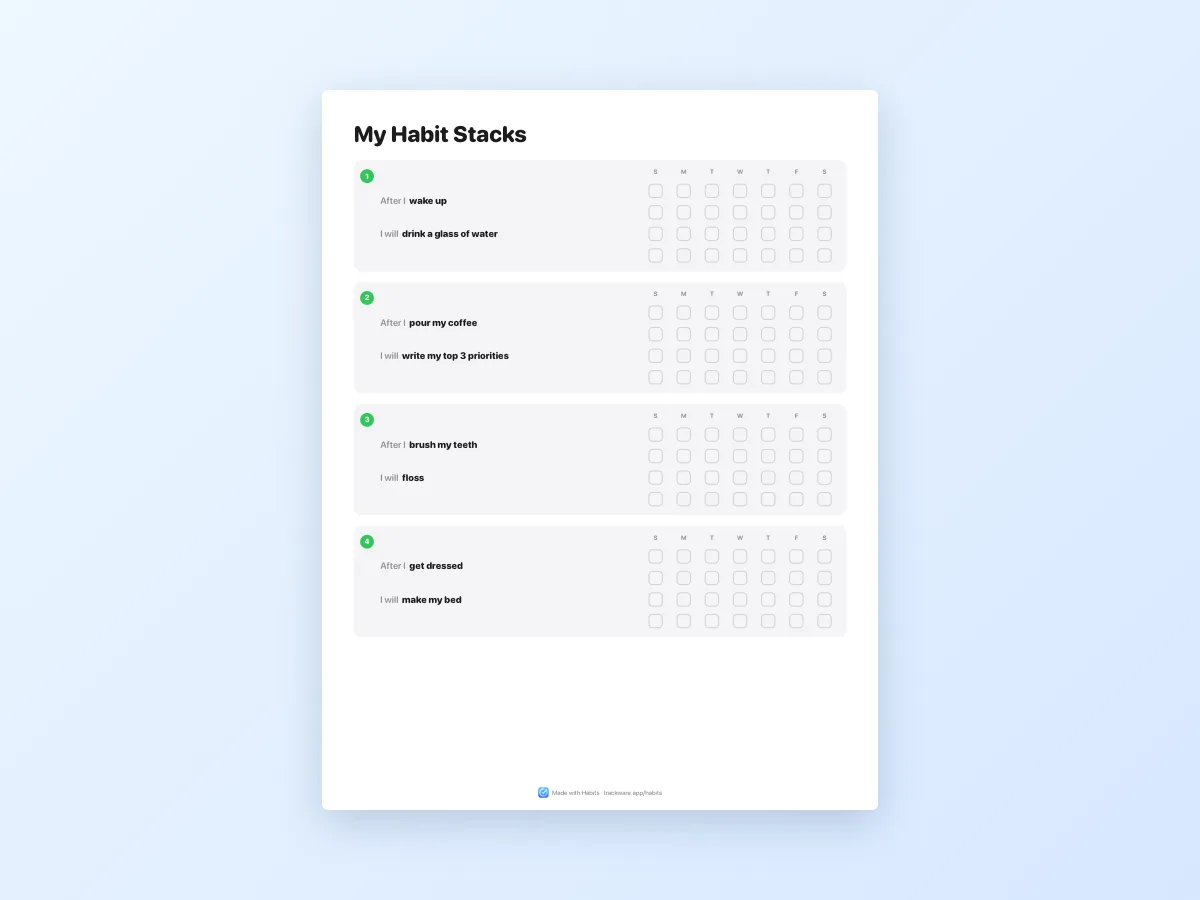
Pair each new habit with something you already do every day, in the form "After I..., I will...". Start from a template, write up to six stacks, and print them with four weeks of checkboxes. Free, no sign-up.
What is habit stacking?
Habit stacking means attaching a new habit to one you already do every day. Instead of "I will meditate more", you decide "After I pour my morning coffee, I will meditate for one minute." The habit you already have becomes the reminder for the new one. The method comes from BJ Fogg, who calls it anchoring, and James Clear made it famous in Atomic Habits. It builds on research about implementation intentions: plans of the form "when X happens, I will do Y".
Why it works
Habits form when the same action follows the same cue. Your current habits are reliable cues: you brush your teeth, make coffee or sit down at your desk every day, at about the same moment. In a large study of gym-goers published in PNAS in 2023, going on the same days of the week was one of the strongest predictors of a lasting habit. Stacking gives your new habit that same regularity.
How to write a good habit stack
Choose an anchor you do every day without fail, and at the right moment: "after I sit down for lunch" works better than "after work", because it is precise. Keep the new habit small enough to do even on a bad day: one minute of meditation, one page, ten squats. Then write the stack down, exactly, and put it where you will see it.
Start with one or two stacks. Once they run on their own, add the next one after them: that is how a stack grows into a routine.
Print your stacks and track them
The printable plan lists each stack with four weeks of checkboxes, so you can check off every day you followed it. If a stack keeps failing, change the anchor rather than forcing it. To see your whole day before you choose where to stack, try the Habits Scorecard, and for a longer view, the printable habit tracker.
Frequently asked questions
Related articles
Habit Stacking: How It Works, 30 Examples and a Free Template
Habit stacking attaches a new habit to one you already do. How it works, the formula, 30 examples for morning, work and evening, and a free printable template.
3 min read
The Two-Minute Rule: How to Use It for Habits (with Examples)
There are two two-minute rules: one for tasks, one for habits. How the two-minute rule for habits works, 20 examples, and why starting small makes habits stick.
2 min read
Habit vs Routine vs Ritual: What's the Difference?
A habit runs on autopilot, a routine is a sequence you choose, a ritual carries meaning. The differences with examples, and how to turn a routine into habits.
3 min read