
Sets per muscle calculator
Write your routine, say how many times a week you do each workout, and see how many sets each muscle really gets, secondary muscles included. 120 exercises are recognized, for 19 muscles.
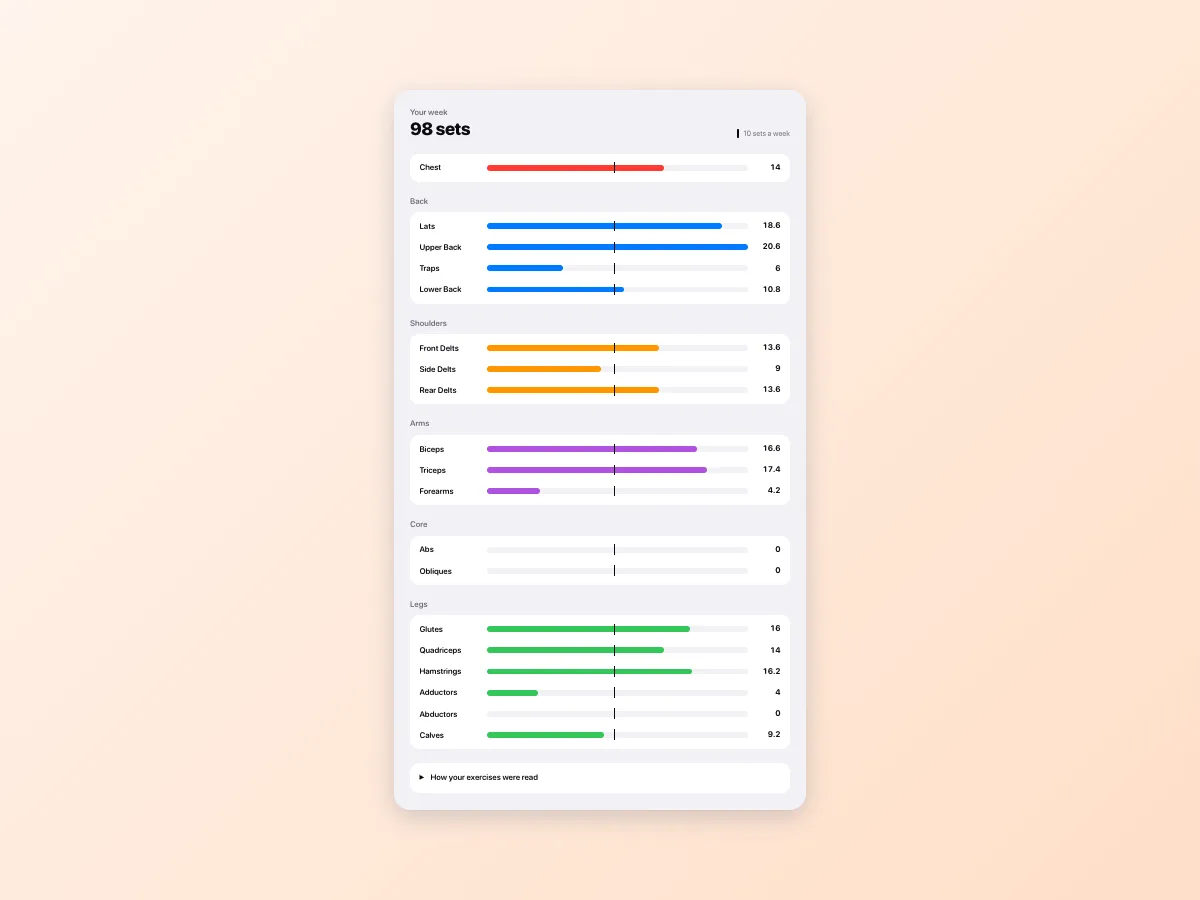
Your week
98 sets
10 sets a week
Chest14
Bench Press 8 · Incline Dumbbell Press 6
Back
Lats18.6
Barbell Row 7.2 · Lat Pulldown 6 · Seated Cable Row 5.4
Upper Back20.6
Barbell Row 8 · Seated Cable Row 6 · Face Pull 3.6 · Lat Pulldown 3
Traps6
Face Pull 3 · Overhead Press 1.8 · Lateral Raise 1.2
Lower Back10.8
Barbell Row 4 · Romanian Deadlift 3.6 · Squat 3.2
Shoulders
Front Delts13.6
Overhead Press 6 · Bench Press 4 · Incline Dumbbell Press 3.6
Side Delts9
Lateral Raise 6 · Overhead Press 3
Rear Delts13.6
Face Pull 6 · Barbell Row 4 · Seated Cable Row 2.4 · Lat Pulldown 1.2
Arms
Biceps16.6
Barbell Curl 6 · Barbell Row 4 · Lat Pulldown 3.6 · Seated Cable Row 3
Triceps17.4
Triceps Pushdown 6 · Bench Press 4.8 · Overhead Press 3.6 · Incline Dumbbell Press 3
Forearms4.2
Barbell Curl 2.4 · Romanian Deadlift 1.8
Core
Abs0
No exercise in your routine.
Obliques0
No exercise in your routine.
Legs
Glutes16
Squat 6.4 · Romanian Deadlift 5.4 · Leg Press 4.2
Quadriceps14
Squat 8 · Leg Press 6
Hamstrings16.2
Romanian Deadlift 6 · Leg Curl 6 · Squat 2.4 · Leg Press 1.8
Adductors4
Squat 4
Abductors0
No exercise in your routine.
Calves9.2
Calf Raise 8 · Leg Curl 1.2
How your exercises were read
Change one if it is not the right exercise.
- Bench Press (8 sets)
- Incline Dumbbell Press (6 sets)
- Overhead Press (6 sets)
- Lateral Raise (6 sets)
- Triceps Pushdown (6 sets)
- Barbell Row (8 sets)
- Lat Pulldown (6 sets)
- Seated Cable Row (6 sets)
- Face Pull (6 sets)
- Barbell Curl (6 sets)
- Squat (8 sets)
- Romanian Deadlift (6 sets)
- Leg Press (6 sets)
- Leg Curl (6 sets)
- Calf Raise (8 sets)
Sets per muscle in Push Pull Legs, Upper Lower and Full body
We ran three templates of this page through the calculator, counting in proportion: Push Pull Legs with each workout twice a week (6 workouts), Upper Lower (4 workouts) and Full body (3 workouts). The number of sets per week depends on the exercises you choose, so compare with your own routine above.
| Muscle | Push Pull Legs | Upper Lower | Full body |
|---|---|---|---|
| Chest | 14 | 7 | 6 |
| Lats | 18.6 | 13.5 | 9.6 |
| Upper Back | 20.6 | 11.5 | 9 |
| Traps | 6 | 3.3 | 3.1 |
| Lower Back | 10.8 | 8.4 | 5.7 |
| Front Delts | 13.6 | 9.8 | 6.3 |
| Side Delts | 9 | 6 | 3.5 |
| Rear Delts | 13.6 | 3.8 | 3.3 |
| Biceps | 16.6 | 9.4 | 6.8 |
| Triceps | 17.4 | 9.5 | 7.1 |
| Forearms | 4.2 | 4.4 | 2.3 |
| Abs | 0 | 0 | 3 |
| Obliques | 0 | 0 | 1.5 |
| Glutes | 16 | 11 | 7.5 |
| Quadriceps | 14 | 11.2 | 7.2 |
| Hamstrings | 16.2 | 10.8 | 6.5 |
| Adductors | 4 | 2 | 1.5 |
| Calves | 9.2 | 8.6 | 3.4 |
How sets are counted
Each exercise has a percentage for every muscle it works. The bench press counts 100% for the chest, 60% for the triceps and 50% for the front delts, so 4 sets give 4 sets of chest, 2.4 of triceps and 2 of front delts. The calculator multiplies by the number of times you do the workout in a week and adds everything up.
Tap a muscle to see which exercises its sets come from. Leave your warm-up sets out of the routine, they are not working sets.
Three ways to count
"In proportion" is the most detailed, and the one the Lifts app uses. "Half sets" counts one set for the main muscles and half a set for those worked at 50% or more, a simple rule found in research: in a meta-regression by Pelland and colleagues, published in Sports Medicine in 2026 (67 studies, 2,058 people), counting indirect sets as half was the method the evidence supported best. "Main only" ignores secondary muscles, so it shows what your routine trains directly.
How many sets per muscle and per week?
There is no single number. A meta-analysis by Schoenfeld, Ogborn and Krieger, published in the Journal of Sports Sciences in 2017 (15 studies), found that more weekly sets went with more muscle growth. The 2026 analysis by Pelland and colleagues found the same, with diminishing returns: each extra set adds less than the one before. The mark on the bars is at 10 sets: it is a landmark to compare your muscles with each other, not a goal to reach everywhere.
Use the result to find what your routine forgets, rear delts, hamstrings or calves for example, or what it repeats without your noticing, like the front delts in three kinds of presses.
Where the percentages come from
They are the ones of Lifts, the workout log we are building for iPhone and Apple Watch, for its 120 built-in exercises. They describe how involved each muscle is in the usual form of the exercise. They are estimates, not measurements: your grip, your stance and your range of motion change them.
Once your routine is balanced
Print it as a workout log or turn it into a spreadsheet for Google Sheets: both read the same text, so you can copy your workouts as they are.